Certified thermal break aluminium doors and acoustic window systems precision-fabricated for residential towers, luxury villas, and commercial developments across Turkey.
A comprehensive technical analysis on structural compliance, thermal optimization, and regional climate resilience for imported fenestration systems in Turkish urban and coastal projects.
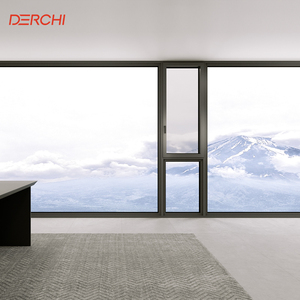
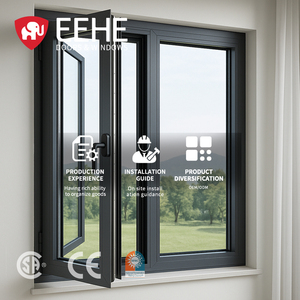
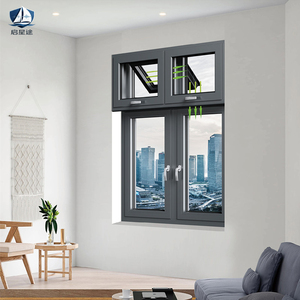
Turkey’s building sector has undergone a profound transformation driven by modernized urban renewal laws, earthquake safety standards, and strict energy efficiency regulations. Central to fenestration design is compliance with TS 825 (Thermal Insulation Requirements in Buildings). As Turkey spans four distinct thermal climate zones—ranging from the mild Mediterranean coasts of Antalya and Bodrum to the harsh continental winters of Central and Eastern Anatolia (Ankara, Kayseri, Erzurum)—balcony doors represent a critical structural plane for preventing envelope thermal bridging.
Architects and developers procurement teams targeting premium project delivery must balance frame thermal transmittance ($U_f$) and glass thermal transmittance ($U_g$). Standard non-broken aluminium profiles are obsolete under current municipal building codes. High-end residential and hospitality developments in Turkey require multi-chamber polyamide thermal break profiles with structural depth ranging from 70mm to 90mm, paired with double or triple insulated glass units (IGUs) incorporating Low-E coatings and argon gas fill to achieve combined $U_w$ values below $1.3 \text{ W/m}^2\text{K}$.
Key Engineering Takeaway for Turkish Importers: Procuring balcony door systems engineered with PA66 GF25 (25% glass fiber reinforced polyamide) thermal break strips ensures structural integrity while easily satisfying TS 825 Zone 2, Zone 3, and Zone 4 energy target thresholds.
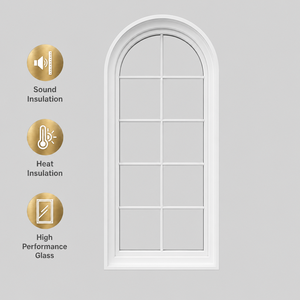
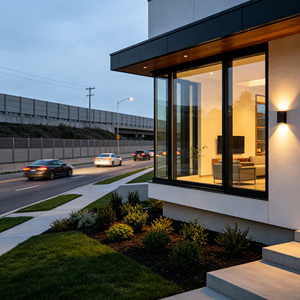
Rapid urbanization in major hubs like Istanbul (Maslak, Kadıköy, Basın Ekspres), İzmir (Bayraklı), and Ankara has placed ambient noise mitigation at the top of real estate buyer criteria. Urban balcony doors are subjected to high decibel traffic noise ($>75 \text{ dB}$). Standard sliding balcony doors frequently fail to provide adequate acoustic isolation due to poor perimeter brush sealing.
To overcome this, our export-grade balcony door systems utilize continuous EPDM (Ethylene Propylene Diene Monomer) compression gaskets combined with multi-point lifting and locking gear. When paired with asymmetrical acoustic laminated glass (e.g., 6mm toughened + 1.52mm PVB + 8mm toughened), our systems achieve sound reduction indices up to STC 48 dB, providing quiet indoor sanctuaries amidst bustling metropolis surroundings.
Turkey sits upon major fault lines (North Anatolian and East Anatolian faults), requiring structural fenestration to endure micro-seismic rackings without glass fracture or frame dislodgement. Furthermore, high-rise luxury towers in Istanbul and coastal villas exposed to Aegean sea gales face intense wind pressure ($p3 \ge 2400 \text{ Pa}$).
Our heavy-duty balcony door profiles are extruded exclusively from prime 6063-T6 and 6063-T5 architectural aluminium alloy. Wall thicknesses are engineered up to 2.2mm at critical stress points, featuring reinforced mullions that pass strict TS EN 12210 Wind Resistance Class C5/B5 testing with deflection limits controlled under $L/300$.
Tailored fenestration solutions customized for the specific environmental stresses and architectural typologies of Turkey’s diverse geography.
Locations: Bodrum, Çeşme, Marmaris, Antalya, Fethiye.
Architectural Challenge: Severe salt spray marine corrosion, high solar radiation, and the desire for ultra-wide, seamless indoor-outdoor terrace integration.
Engineering Solution: Slimline Lift-and-Slide balcony doors treated with Qualicoat Class 2 / Marine-Grade 25µm Anodized surface finishes. Heavy-duty stainless steel SUS316 rollers resist saline pit corrosion, allowing expansive glass panels up to 400kg per leaf to slide effortlessly.
Locations: Maslak, Levent, Ataşehir, Kadıköy (Istanbul), Bayraklı (İzmir).
Architectural Challenge: Structural wind load at heights above 100 meters, sound isolation against highway/urban noise, air permeability reduction.
Engineering Solution: Heavy-duty thermal break casement balcony doors equipped with German Siegenia or Roto multi-point lock hardware. High compression EPDM triple gaskets guarantee Class 4 air permeability (EN 12207) and Class E1050 water tightness (EN 12208).
Locations: Ankara, Kayseri, Konya, Eskişehir, Erzurum.
Architectural Challenge: Sub-zero winter temperatures down to -25°C coupled with intense summer thermal heat gain.
Engineering Solution: Triple-glazed 90mm series thermal break tilt-and-turn balcony doors featuring 34mm polyamide isolation strips. Combined with Low-E hard coat glazing units, solar heat gain coefficient (SHGC) and U-factors remain optimal year-round.
Locations: Cappadocia Cave Hotels, Bosphorus Waterfront Restorations, Commercial Plaza Cafe Terraces.
Architectural Challenge: Aesthetic elegance, flexible spatial opening, combined with instant privacy control options.
Engineering Solution: Magnetic Levitation sliding balcony doors and motorized bi-folding glass walls integrated with PDLC Switchable Smart Glass, shifting from crystal clear to opaque privacy at the push of a button.
Direct technical baseline data comparing our system typologies for Turkish project procurement teams.
| System Typology | Thermal Transmittance (Uw) | Acoustic Isolation (STC) | Wind Load Class (EN 12210) | Max Sash Weight | Recommended Turkish Application |
|---|---|---|---|---|---|
| Thermal Break Lift & Slide Door | 1.1 – 1.4 W/m²K | 38 – 42 dB | Class C4 / B5 | 400 kg | Bodrum & Antalya Sea-Facing Villa Terraces |
| Heavy-Duty Tilt & Turn Balcony Door | 0.8 – 1.2 W/m²K | 42 – 48 dB | Class C5 | 160 kg | Ankara & Istanbul High-Rise Apartments |
| Minimalist Slimline Glass Slider | 1.3 – 1.6 W/m²K | 35 – 40 dB | Class C3 | 300 kg | Modern İzmir & Bursa Penthouse Balconies |
| Maglev Trackless Sliding Door | 1.2 – 1.5 W/m²K | 40 – 44 dB | Class C4 | 250 kg | Luxury Hotel Suites & Bosphorus Residences |
| Triple-Glazed Bi-Folding Balcony Wall | 1.0 – 1.3 W/m²K | 38 – 43 dB | Class C3 / B4 | 120 kg / panel | Restaurant Terraces & Commercial Enclosures |
25+ years of dedicated aluminium fabrication mastery, delivering full vertical integration, custom engineering, and streamlined sea logistics to Turkish ports.
Our patented magnetic levitation sliding technology eliminates mechanical wheel friction, allowing ultra-heavy balcony doors to glide silently with minimal force, extending hardware service life indefinitely.
We use virgin primary aluminium billets (6063-T5/T6 grade) to extrude profiles with flawless structural density, high tensile strength, and superior surface finish receptivity for powder coating or anodizing.
Before cutting a single aluminium section, our dedicated engineering studio issues comprehensive CAD shop drawings detailing sightlines, structural drainage, anchoring points, and U-value calculations for architect sign-off.
Every balcony door order undergoes full factory dry-assembly, diagonal squareness verification, seal tightness testing, and multi-point hardware operation cycling prior to export crating.
We possess deep export experience routing FCL (Full Container Load) shipments directly to major Turkish ports: Ambarlı / Haydarpaşa (Istanbul), Alsancak / Nemrut (İzmir), and Mersin Port, complete with ATR documentation support.
Offering over 200 electrostatic powder-coated RAL shades—including popular Turkish architectural colors like RAL 7016 Anthracite Grey, RAL 9005 Jet Black, and Textured Metallic Finishes—alongside 3D heat-transfer wood textures.
Addressing crucial technical, legal, customs, and logistics inquiries from Turkish architectural firms, contractors, and fenestration importers.
Yes. All of our thermal break aluminium balcony door series are engineered specifically to meet or exceed Turkish TS 825 requirements. By utilizing multi-chamber polyamide thermal barriers (PA66 GF25) alongside double or triple glazed Low-E units filled with Argon gas, our doors achieve overall thermal transmittance rates ($U_w$) as low as $0.8 \text{ W/m}^2\text{K}$ to $1.3 \text{ W/m}^2\text{K}$, making them suitable for all thermal zones in Turkey including Zone 4 (Eastern Anatolia).
Production standard lead time is 4 to 6 weeks following CAD shop drawing approval. Direct ocean freight transit from our factory port to major Turkish container hubs—such as Ambarlı or Haydarpaşa (Istanbul), Alsancak or Nemrut (İzmir), and Mersin—typically ranges between 18 to 25 days depending on the shipping line selected. We handle all export packing into heavy-duty fumigated wooden A-frame crates designed for safe maritime transit.
For coastal applications exposed to high salt aerosol levels and moisture, we apply Qualicoat-certified marine-grade powder coatings (60–80 microns thick) or anodized surface finishes (25 microns thick). Furthermore, all visible hardware components, rollers, hinges, and assembly screws are constructed from premium grade SUS316 stainless steel to ensure lifetime resistance against saline pitting oxidation.
Absolutly. We operate entirely on a bespoke architectural fabrication basis. We do not restrict project teams to standard stock sizes. Our engineering division works directly from your DWG/BIM drawings, structural opening dimensions, wind-load calculation schedules, and glass specification requests to create tailored fenestration shop drawings for client sign-off.
We integrate premier European hardware brands including Siegenia, Roto, G-U, and Sobinco, as well as our own high-end proprietary heavy-duty multi-point locking gear. Multi-point perimeter locking bolts ensure perimeter compression against EPDM weather gaskets, providing exceptional burglar resistance (RC2 / RC3 security grade rating) and maximum acoustic sealing.
We supply a complete export documentation suite required by Turkish Customs (Gümrük), including Commercial Invoice, Detailed Packing List with net/gross weights and CBM data, Bill of Lading (B/L), Certificate of Origin (COO), CE Compliance Declarations, and factory test reports matching HS Codes for aluminium windows and doors (HS Code 7610.10).
For international ocean freight projects, our optimal baseline is one 20ft or 40ft container load (or a single full project scope for luxury villas/towers). However, for specialized commercial distributors or trial project evaluation in Turkey, we accept consolidated project orders. Contact our sales engineering team to discuss flexible order grouping.
We provide a comprehensive multi-year manufacturer warranty: 10 years on aluminium profile structural integrity and surface coatings, 5 years on double/triple glazed seal integrity against condensation, and 5 years on mechanical hardware operation. Spare hardware kits, gaskets, and remote video commissioning support are dispatched with every project consignment.
Send us your architectural drawings, elevation schedules, or opening dimensions. Our senior fenestration engineers will provide a complete technical proposal, U-value breakdown, and factory-direct price quotation.