
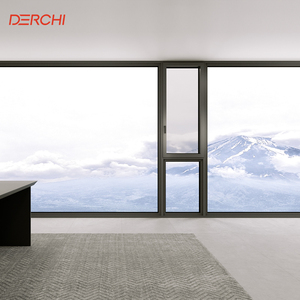
Selected high-performance aluminium arch window configurations for luxury villas, commercial developments, and high-acoustic envelope projects.
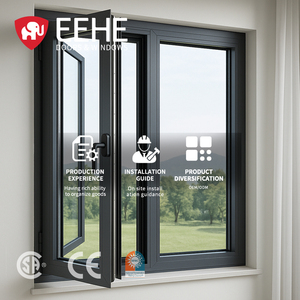
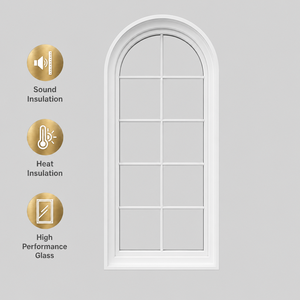
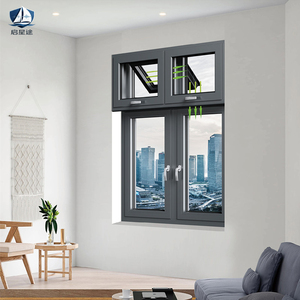
Arched windows—spanning Roman semi-circular curves, Gothic pointed arches, Mediterranean eyebrow radiuses, and modern minimalist curvature—represent one of the most challenging segments in architectural glazing fabrication. Unlike standard rectangular aluminum casement or sliding windows, custom curved windows demand advanced cold-stretch profile bending metallurgy, multi-axis CNC machining, structural thermal barrier integrity, and custom curved insulated glass unit (IGU) lamination.
China has solidified its position as the premier global manufacturing hub for high-performance architectural aluminum arch windows. Exporting over 40% of the world's custom architectural glazing systems, leading Chinese suppliers combine vertical integration—spanning raw billet extrusions, polyamide thermal break assembly, automated bending, anodizing, and IGU sealants—with strict compliance with Western performance standards including NFRC (National Fenestration Rating Council), AAMA, European CE (EN 14351-1), and Australian AS2047 specifications.
Achieving flawless geometric curvature without structural wrinkling or springback deviation requires rigorous metallurgical control. Leading Chinese exporters utilize primary architectural aluminum alloys conforming to international standards:
During the stretch-bending process, the neutral axis of the aluminum extrusion shifts toward the inner compression radius. Inferior suppliers using manual 3-roller bending machines often encounter wall-thickness thinning on the outer tension wall or buckling on the inner flange. Premier manufacturers employ 3D laser-guided CNC cold stretch-bending equipment that maintains profile wall tolerances within ±0.15mm and radius consistency within ±0.5mm across spans exceeding 3 meters.
Comparative engineering parameters for evaluating China arch window suppliers during technical audits.
| Performance Parameter | Standard Commercial Grade | Premium Export Grade (DERCHI / EEHE / Tejjsons Level) | Test Standard / Certification |
|---|---|---|---|
| Aluminium Billet & Alloy | Recycled aluminum profile (6063-T5) | 100% Primary Virgin Ingot (6063-T5 / T6) | GB/T 5237 / ASTM B221 |
| Profile Bending Precision | ±2.5mm radius deviation | ±0.5mm laser-verified radius accuracy | 3D Laser Profiling / CNC Inspection |
| Thermal Insulation (U-Factor) | 2.4 – 3.2 W/m²K (Non-broken) | 0.79 – 1.4 W/m²K (Thermally Broken) | NFRC 100 / EN ISO 10077-2 / Passive House |
| Acoustic Rating (STC / OITC) | STC 28 - 32 dB | STC 42 - 48 dB (Triple Glazed Laminated) | ASTM E90 / ASTM E1425 soundproof rating |
| Surface Finish & Micron | Powder Coating 40 – 50μm | AkzoNobel / PPG PVDF Fluorocarbon 60 – 80μm | AAMA 2605 / Qualicoat Class 2 |
| Glazing Unit Build-Up | Single 6mm or Standard DGU (5+9A+5) | Low-E Triple DGU + Argon Gas + Warm Edge Spacer | IGCC / SGCC / EN 1279 Certified |
| Air Infiltration & Water Resistance | Air Class 3 / Water 300 Pa | Air Class 4 (0.06 cfm/ft²) / Water 700+ Pa | ASTM E283 / ASTM E331 / AS2047 |
Core competencies that distinguish tier-1 Chinese manufacturers in international B2B architectural projects.
Complete control from raw billet extrusions and aluminum anodizing to automated thermal break insertion and customized curved glass assembly under a single factory roof.
Engineered systems certified for extreme cold and tropical hot climates, featuring polyamide PA66-GF25 structural thermal breaks and triple Low-E insulated glass units.
Heavy-duty steel A-frame crate packaging, EPDM protective rubber corner guards, labeled hardware kits, and full customs documentation for smooth global delivery.
In-house CAD engineering team delivering 3D structural calculations, wind-load analysis (ASTM E1300), and detailed shop drawings for architectural sign-off before fabrication.
Integrated multipoint locking mechanisms from Siegenia, Roto, and Hoppe, as well as hidden motorized actuators compatible with smart building automation system (BAS) platforms.
Every custom arched frame undergoes 100% pre-assembly, diagonal tolerance verification, 5-bar water spray testing, and operational cycle testing prior to export packing.
The global architectural fenestration sector is undergoing a massive shift driven by decarbonization mandates, smart home integration, and modern architectural aesthetics. B2B procurement managers, real estate developers, and facade consultants must evaluate several key technological evolutions when selecting a long-term manufacturing partner in China.
Traditional roll-bending machines relied heavily on technician experience, often leading to slight radius variations between window batches. Top Chinese suppliers are adopting automated 3D laser scanner profiling during stretch bending. Real-time optical sensors detect micro-deviations in extrusion cross-sections and automatically adjust hydraulic pressure to compensate for alloy springback. This ensures 100% dimensional consistency across large-scale commercial arch window contracts.
Historically, bending thermally broken aluminum profiles presented a significant risk of de-crimping or shearing the polyamide (PA66-GF25) structural strip. Next-generation Chinese manufacturing facilities utilize warm-induction bending systems and pre-shaped flexible thermal barrier polymers. This innovation allows tight radius curves (down to R=300mm) without compromising the thermal insulation or structural shear strength of the frame.
The integration of switchable polymer-dispersed liquid crystal (PDLC) and electrochromic smart glass into arched frames is accelerating rapidly. China’s leading arch window exporters are now laminating PDLC films directly within curved double-glazed units. This provides instant privacy control and dynamic solar heat gain coefficient (SHGC) modulation via smartphone apps, wall keypads, or automated building management systems (BMS).
With Western markets enforcing strict Environmental Product Declarations (EPD) and green building rating systems (LEED v4.1, BREEAM, WELL), top Chinese manufacturers are transitioning to low-carbon aluminum billets smelted using renewable hydroelectric power. Utilizing post-consumer recycled aluminum with certified low embodied carbon (<4.0 kg CO2e/kg Al) enables developers to achieve sustainability targets without sacrificing structural integrity.
Importing custom-shaped glass and curved aluminum frames requires specialized export packaging to withstand multi-modal sea freight, port handling, and container transit. Top China exporters implement a rigid multi-tier protective wrapping protocol:
Non-residue protective PE film applied to aluminum profile surfaces to prevent scratches during handling and assembly.
Heavy-duty EPDM rubber and cellular foam edge guards protect delicate arch corners from impact damage.
Desiccant-infused shrink wrapping prevents moisture condensation and salt-air oxidation inside ocean containers.
Fumigation-free plywood or customized steel A-frame crates secured with heavy-duty tension strapping for forklift transport.
By specifying factory-direct sea freight in full container loads (FCL) or specialized LCL A-frame crates, international buyers achieve a Total Cost of Ownership (TCO) that is typically 35% to 50% lower than regional Western fabricators, even after accounting for international freight, customs duties, and local logistics.
Detailed answers to technical, logistical, and commercial inquiries commonly raised by global specifiers and importers.
Connect directly with China's leading engineering team for CAD drawing reviews, NFRC/CE performance calculations, and factory-direct project quotes.