Architectural grade double & triple glazed casement, sliding, arched, and soundproof window solutions engineered for global building certifications.
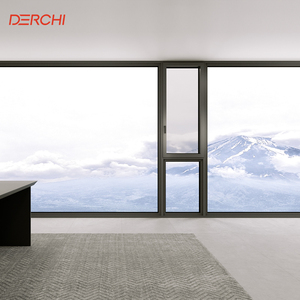
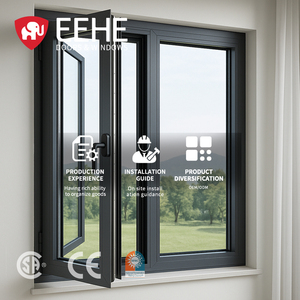
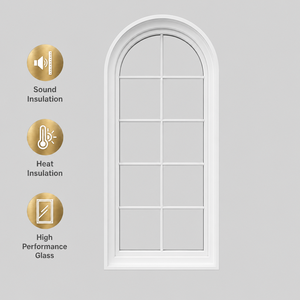
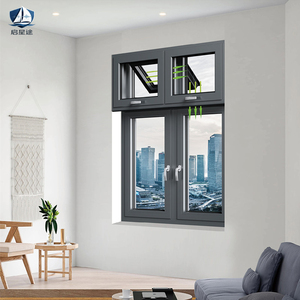
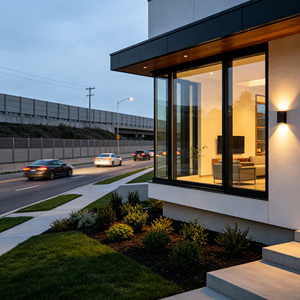
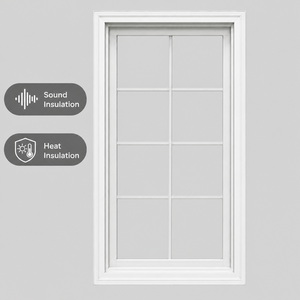
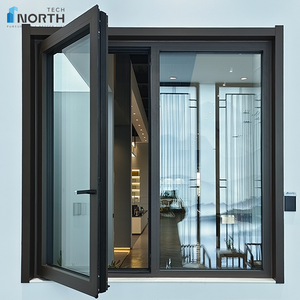
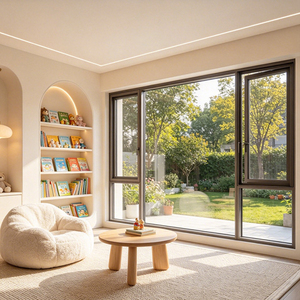
Low-Emissivity (Low-E) glass has fundamentally shifted modern architectural design by providing ultra-efficient thermal control without compromising visible light transmission. Emissivity refers to a surface's ability to radiate heat. Standard clear float glass exhibits an emissivity ($\epsilon$) of approximately 0.84, whereas advanced off-line Magnetron Sputtering Vacuum Deposition (MSVD) Low-E coatings engineered in China's leading manufacturing centers achieve emissivity values as low as 0.02 to 0.04.
This microscopic metallic layer—primarily composed of silver (Ag) sandwiched between dielectric ceramic antireflection layers (such as zinc oxide and titanium dioxide)—reflects long-wave infrared heat back to its source. In cold climates, indoor heat is retained; in tropical or hot climates, solar thermal radiation (short-wave infrared) is reflected externally, drastically reducing heating, ventilation, and air-conditioning (HVAC) loads.
Technical Information Gain: Off-line Triple-Silver Low-E configurations (e.g., $Ag/Ag/Ag$ nano-layers) achieve a Light-to-Solar Gain (LSG) ratio exceeding 2.15. This allows max visible light transmittance (VLT > 65%) while holding the Solar Heat Gain Coefficient (SHGC) under 0.28, representing the gold standard for LEED v4.1 and zero-carbon building envelopes.
Ideal for moderate climatic zones. Provides baseline thermal insulation (U-value ~1.8 W/m²K in DGU) with high visible light transparency, making it suitable for residential windows and medium-rise developments.
Features two discrete silver layers. Delivers enhanced solar heat rejection (SHGC 0.30 - 0.40) while maintaining crisp optical clarity, tailored for high-exposure luxury villas, commercial towers, and hotels.
Employs three silver layers applied via 20+ vacuum chambers. Provides supreme solar blocking (SHGC < 0.23) with negligible color shift, designed specifically for extreme desert or tropical envelope specifications.
When evaluating structural low-E window assemblies from China suppliers, architects and facade engineers analyze key spectrophotometric indices. The following matrix illustrates standardized performance profiles across double-glazed (IGU/DGU) and triple-glazed (TGU) system configurations utilizing architectural 6063-T5/T6 thermal break profiles.
| Glazing Configuration | Visible Light Trans. (VLT %) | Solar Heat Gain (SHGC) | U-Factor (W/m²K NFRC) | Acoustic Rating (STC) | Target Architectural Application |
|---|---|---|---|---|---|
| 6mm Clear Low-E + 12Ar + 6mm Clear (DGU) | 70% | 0.38 | 1.45 | 36 dB | Standard High-Rise Residential & Offices |
| 6mm Double-Silver Low-E + 16Ar + 6mm Clear | 62% | 0.28 | 1.28 | 38 dB | Luxury Coastal Villas & Star Hotels |
| 6mm Triple-Silver + 12Ar + 6mm + 12Ar + 6mm (TGU) | 55% | 0.22 | 0.79 | 42 dB | Passive House Certified (NT91 Standard) |
| 8mm Laminated Soundproof + 16Ar + 6mm Low-E | 64% | 0.32 | 1.30 | 48 dB | Urban Commercial, Airport & Hotel Facades |
The global demand for high-performance building envelopes has transformed procurement methodologies. Key technological and market trends shaping international sourcing from Chinese glass manufacturers include:
Vacuum Insulating Glass (VIG) eliminates gas conduction by creating a high-vacuum micro-cavity ($10^{-4}$ Pa) between glass panes held apart by microscopic support pillars. Combining Low-E soft coatings with VIG units yields thermal U-values as low as 0.40 W/m²K in ultra-thin profiles (under 12mm total glass thickness). This allows historical building retrofits and modern minimalist frames to achieve unprecedented efficiency without bulky sightlines.
A Low-E glass unit is only as effective as the frame surrounding it. Leading Chinese suppliers integrate high-grade 6063-T5 and T6 extruded aluminium profiles featuring Technoform polyamide (PA66GF25) thermal barriers. Multi-chamber designs filled with aerogel insulation prevent thermal bridging, ensuring zero frame condensation in high-humidity zones.
The convergence of Electrochromic (EC) smart glass and Building-Integrated Photovoltaics (BIPV) with low-emissivity magnetron coatings is accelerating. Modern commercial projects increasingly specify hybrid windows that automatically modulate solar heat ingress via sensor-driven micro-currents while generating clean solar power along exterior building spandrels.
Partnering directly with established China manufacturers provides global developers, contractors, and architects with distinct structural and economic advantages. Drawing upon decades of specialized fabrication experience, enterprise capabilities encompass complete vertical integration:
Addressing core technical, logistical, and commercial inquiries regarding custom architectural window systems and Low-E glass import operations:
Connect with our senior facade engineering team today. Submit your CAD elevation drawings, schedule requirements, or performance targets to receive comprehensive shop drawings, factory-direct pricing, and technical proposals within 24 hours.