Explore our factory-engineered window products verified for structural integrity, acoustic damping, and strict EU/North American compliance.
Understanding the shifting compliance requirements, decarbonization goals, and technical benchmarks defining B2B window procurement through 2030.
International commercial developers and residential general contractors no longer treat CE certification as a secondary compliance check. Under strict European Construction Products Regulation (CPR) and harmonized standard EN 14351-1, windows exported into European and allied markets must provide audited Declarations of Performance (DoP).
Furthermore, procurement officers are mandating Environmental Product Declarations (EPDs) that measure embodied carbon from raw 6063-T6 aluminum extrusion through fabrication and container sea-freight packaging.
With global energy costs soaring and municipal building codes lowering thermal transmission caps, architectural window exporters are experiencing unprecedented demand for Uw values ≤ 0.8 W/(m²·K). This trend pushes specifying architects away from standard non-thermal aluminum frames toward multi-chamber polyamide thermal break profiles (PA66 GF25).
Advanced triple-glazed units incorporating double argon-filled cavities, warm-edge spacers, and Low-E soft coatings have transitioned from luxury options to baseline procurement specifications for mid-to-high-rise residential developments.
Rapid urbanization near transport hubs, airports, and commercial centers has prioritized Sound Transmission Class (STC) and Outdoor-Indoor Transmission Class (OITC) ratings. Exporters must provide validated soundproof testing reports showing attenuation between STC 38 dB and STC 48 dB.
Achieving these acoustic thresholds requires engineered asymmetrical laminated glass configurations (e.g., 6mm Low-E + 1.52PVB + 8mm clear) paired with multi-layer continuous EPDM synthetic rubber gasket seals that eliminate perimeter sound leakage.
Discover how material science, structural engineering, and automated glass fabrication are redefining window export standards.
Aluminum is inherently conductive. To counteract thermal bridging, modern architectural casement and sliding frames incorporate 24mm to 34mm techno-polymer polyamide strips reinforced with 25% glass fiber (PA66 GF25). This composite strip structurally joins interior and exterior aluminum extrusions while drastically reducing thermal conductivity.
Next-generation profiles feature cellular insulation foam inserts inside profile chambers and multi-cavity perimeter seals, suppressing convection currents inside the frame cavities to guarantee frost-free interiors in sub-zero climates and reduced HVAC load in hot tropical zones.
One of the most revolutionary shifts in modern fenestration is the elimination of mechanical friction in heavy architectural glass panels. Proprietary Magnetic Levitation (Maglev) window systems replace traditional roller bearings with linear magnetic coils.
Over-sized glazed sashes weighing up to 400 kg glide effortlessly across stainless steel guide tracks with single-finger operational force. When paired with hidden low-voltage motor drives, these systems integrate directly into modern smart home automation protocols (KNX, BACnet, or mobile app control) for automated micro-ventilation and touchless access.
Fenestration export specs are increasingly calling for dynamic glass integration. Polymer Dispersed Liquid Crystal (PDLC) switchable smart privacy glass allows sashes to transition from crystal-clear transparency to completely opaque in under 100 milliseconds upon electrical charge, replacing mechanical blinds in luxury hospitality and corporate boardrooms.
Simultaneously, Vacuum Insulated Glass (VIG)—which replaces argon gas gaps with a microscopic 0.2mm vacuum space—delivers center-of-glass thermal performance equivalent to solid brick masonry (U-values down to 0.4 W/m²·K) at a fraction of the frame depth and weight.
Structural window frames exposed to coastal salt air, extreme solar UV radiation, and industrial pollutants demand superior surface treatment protocols. High-tier architectural window exporters utilize electrostatic fluorocarbon (PVDF) 3-coat paint finishes or Qualicoat Class 2 / Class 3 certified powder coatings applied at 60–80 microns.
For marine environments, 15 to 25-micron anodic oxidation (anodizing) provides a uniform oxide barrier that resists filiform corrosion, chalking, and color fading for over 25 years without delamination.
| Performance Metric | Standard Commercial Window | CE Certified Architectural Export Standard | Engineering Significance |
|---|---|---|---|
| Profile Material & Alloy | Standard Recycled Aluminum | 6063-T5 / 6063-T6 Primary Virgin Alloy | Ensures structural yield strength > 170 MPa & precise extrusion tolerances |
| Overall Thermal Transmittance (Uw) | 2.2 – 2.8 W/(m²·K) | 0.8 – 1.4 W/(m²·K) (Thermally Broken) | Substantially lowers HVAC operational energy consumption |
| Acoustic Damping (Rw / STC) | 25 – 30 dB | 38 – 48 dB (Asymmetric Laminated DGU) | Blocks low-frequency urban traffic & aircraft noise pollution |
| Wind Load Resistance (EN 12210) | Class 3 (1200 Pa) | Class C5 / P3 (Up to 3000+ Pa / 5.0 kPa) | Prevents frame deflection and structural glass blowout in typhoon zones |
| Water Tightness (EN 12208) | Class 5A (200 Pa) | Class E1500 (1500 Pa static pressure) | Prevents rainwater ingress under hurricane-force driving wind |
| Hardware & Lock Security | Single-Point Latch | European Multipoint Gear Drive & Security Keepers | Achieves RC2/RC3 burglar resistance and uniform gasket compression |
Combining 25+ years of window fabrication heritage with rigorous export logistics, custom shop drawing validation, and European hardware integration.
From raw profile extrusion handling and CNC 5-axis precision machining to automated Insulated Glass Unit (IGU) assembly and powder coating coordination, our integrated manufacturing plant keeps every step under unified Quality Assurance (QA). This internal oversight guarantees structural tolerances within ±0.5mm across complex multi-window project schedules.
Sea freight transit introduces vibration, humidity, and rough multi-leg handling. We safeguard your investment using customized heavy-duty export packaging: profile sashes are wrapped in protective PE film, corners are shielded with high-density EVA foam buffers, and glass units are secured in reinforced steel-frame or wooden A-frame crates with desiccants to prevent glass etching during transit.
Before cutting any aluminum profile, our dedicated facade engineering team reviews your architectural elevation plans, structural floor plans, and localized wind-load calculations. We output comprehensive 2D CAD shop drawings detailing perimeter anchoring, flashing details, drainage paths, sightlines, and glass schedules for formal engineer sign-off.
Direct, technical answers to common queries raised by international developers, project specifiers, and window importers.
Our CE certification process adheres strictly to harmonized standard EN 14351-1 (Windows and Doors). Every exported window series undergoes Initial Type Testing (ITT) by an accredited European notified body to measure key metrics: Air Permeability (EN 12207), Water Tightness (EN 12208), Wind Load Resistance (EN 12210), Operating Forces (EN 12046-1), and Thermal Transmittance (EN ISO 10077-1/-2).
Each consignment ships with official Declarations of Performance (DoP), factory production control (FPC) audit documentation, and CE label marking applied directly to frame sashes for seamless customs verification.
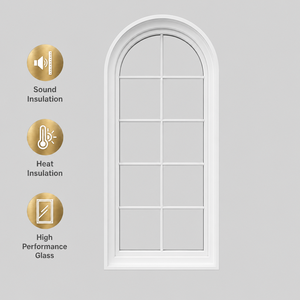
Production lead time for standard thermally broken casement and sliding windows typically ranges from 4 to 6 weeks following final shop drawing sign-off and color sample approval. Complex orders involving proprietary Magnetic Levitation systems, custom arched profiles, motorized openers, or switchable smart glass take approximately 6 to 8 weeks.
Transit times by sea container depend on destination ports: approximately 18–25 days to Middle Eastern ports, 25–35 days to European ports, and 30–40 days to North American coastal destinations.
Yes. For coastal developments, high-rise towers, and tropical typhoon regions, our structural engineers calculate wind load deflection in accordance with localized codes (such as ASCE 7, Eurocode 1, or AS/NZS 1170). Frame inertia is reinforced using heavy-wall 6063-T6 aluminum extrusions (up to 3.0mm wall thickness) and internal steel profile stiffeners where necessary.
Systems tested under static pressure withstand up to 5.0 kPa (5000 Pa), equivalent to Class C5 wind resistance under EN 12210 and sustained wind speeds exceeding 250 km/h.
For international shipments, we generally work on a full container load (1x20GP or 1x40HQ container) or complete project-based order scopes. Packing mixed window types (casements, minimal sliders, curtain wall sections) within a single container optimizes sea-freight costs per unit for project developers.
For regional distributors or architectural firms evaluating fabrication quality, trial sample orders or partial container shipments (LCL in wooden crates) can be arranged upon technical review.
Hardware failure is the leading cause of window warranty claims. To prevent operational degradation, we standardize on premium European multipoint hardware platforms, including SIEGENIA, ROTO Frank, Hoppe, and GU (Grettsch-Unitas), along with high-grade proprietary stainless steel (SUS304 / SUS316) concealed hinges and multipoint lock keeps.
For cold climates, we utilize deep 34mm polyamide thermal breaks, warm-edge composite spacers (TGI or Swissspacer), and triple glazing with double argon gas fill and dual silver Low-E coatings to retain radiant heat indoors. For hot tropical climates (e.g., Middle East or Southeast Asia), we specify solar-control Low-E coatings with low Solar Heat Gain Coefficients (SHGC ≤ 0.25) to block infrared solar heat while maintaining daylight transmittance.
All exported window frames carry a 10-Year Structural and Profile Finish Warranty covering powder coating integrity against peeling, flaking, or excessive color shift. Insulated glass units are backed by a 5 to 10-Year Seal Integrity Warranty against internal fogging or desiccant failure.
Multipoint hardware operators and gasket seals are covered by a 5-Year Replacement Warranty. Every exported container includes a supplementary spare hardware kit (handles, keepers, friction stays, gaskets) to ensure uninterrupted installation on site.
Upload your architectural elevations, window schedules, or project tender specs for a free engineering evaluation, U-value estimate, and competitive export quotation.